

British artist David Hockney died yesterday at the age of 88. Over the years, I have had the occasion to write about Hockney. Sometimes it was for stories about other people, like my New York Times profile in 2000 on British designer Ossie Clark:
In 1962, Clark won a scholarship to the Royal College of Art in London, where he met David Hockney, a fellow student. In 1964, Clark moved in with [textile designer Celia] Birtwell, and despite his later homosexual liaisons, they began a love affair that would consume him to the day he died. That year was pivotal for Clark: he acknowledged his homosexual side by seducing Hockney, and together, they traveled to the United States, where Hockney introduced Clark to the glamorous life of Hollywood. Clark returned to London with a cache of Pop Art materials and a head full of ideas.
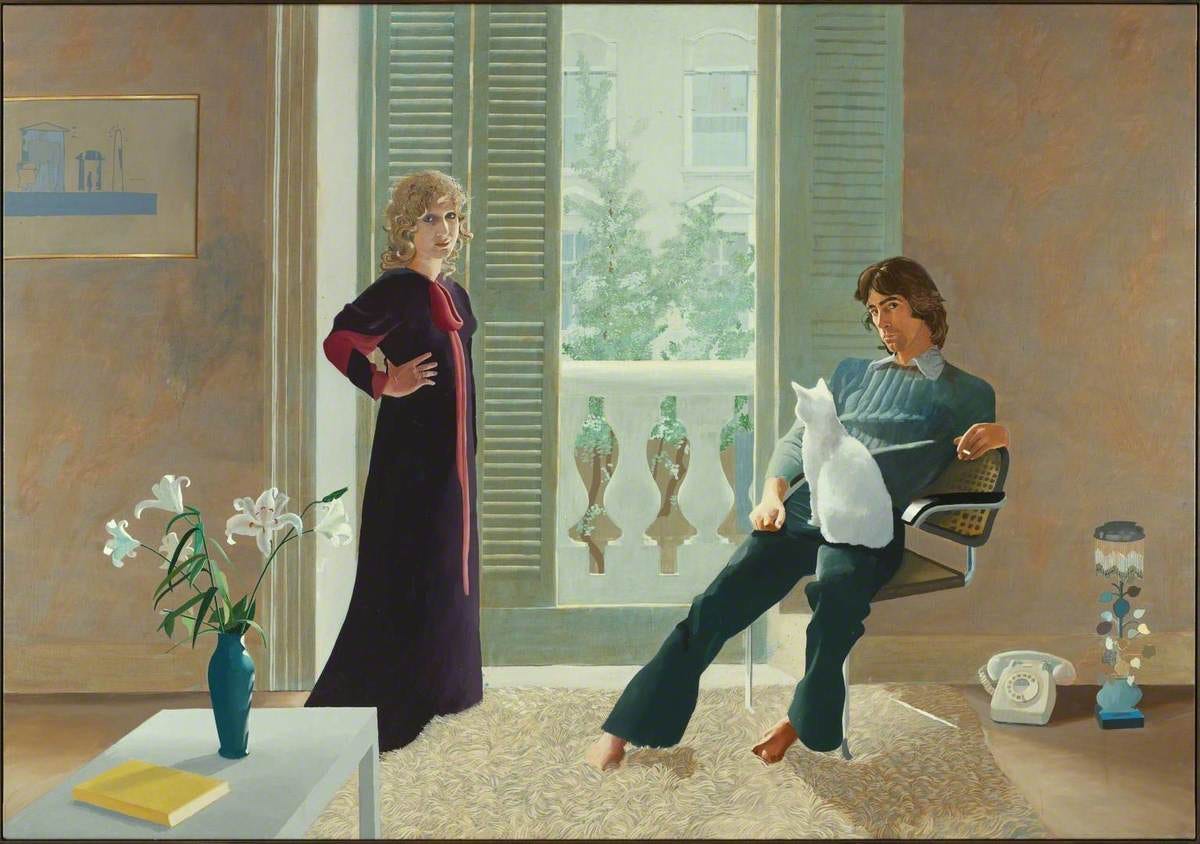
Six years later, Hockney painted one of his most famous portraits, “Mr. and Mrs. Clark and Percy,” of Clark, Birtwell and their cat in their flat in Notting Hill Gate. It is now in the permanent collection at the Tate Britain.
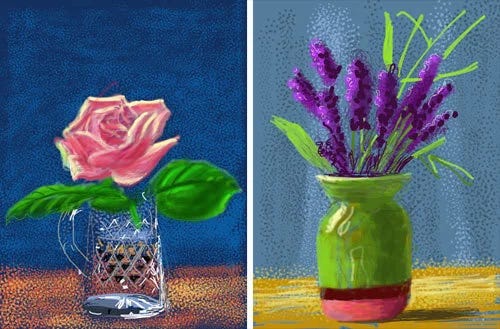
And sometimes I wrote about Hockney’s exhibitions in Paris—there were many, including the jaunty, modernist “Fleurs fraîches: Dessins sur iPhone et iPad” at the Musée Yves Saint Laurent Paris in 2010, and last year’s blockbuster, “David Hockey 25” at the Fondation Louis Vuitton.
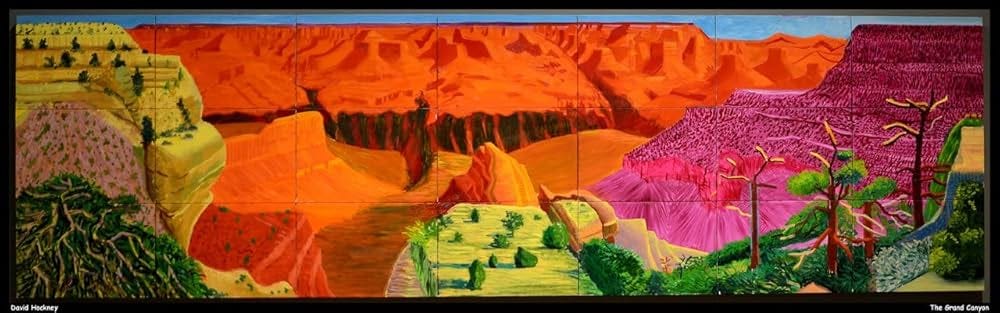
My favorite, however, was “Espace/Paysages,” an exhibition of Hockney's landscapes at the Centre Pompidou in Paris in early 1999. On a cold February morning, I toured the exhibition with Hockney himself for a story I was writing for Newsweek. The centerpiece was a suite of vibrant paintings of the Grand Canyon and I had the rare opportunity to hear him describe the thinking and technique behind them. Unfortunately, Newsweek’s current owners no longer make articles from that far back available online—at least not mine. But I still have a draft in my computer. I’m running it below. Enjoy.
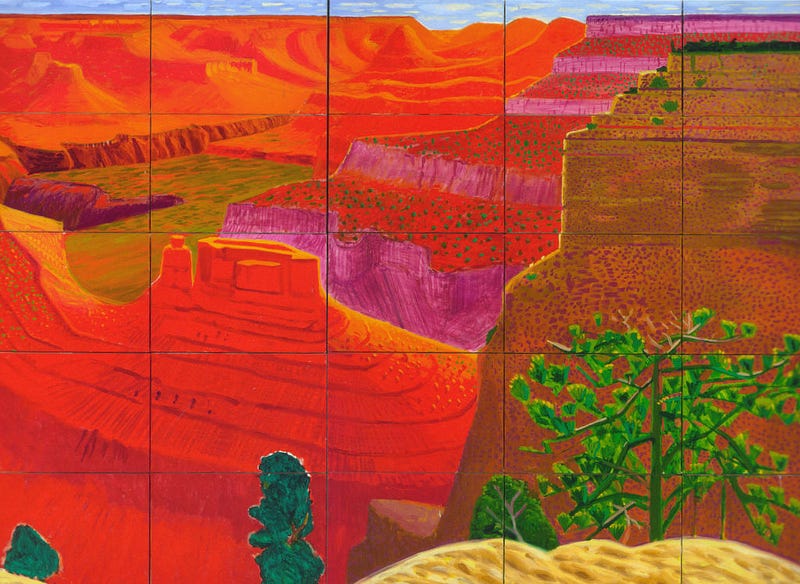
Last winter, David Hockney embarked on one of the greatest challenges in art: to capture the Grand Canyon on canvas. “You look in every direction, and there is no perspective, no focal point,” he explains. To overcome this, Hockney planted himself on the Arizona bluff like the Mars rover and visually recorded the rocky crevices in the round. He then spread the view in eye-burning colors across 60 canvases, which, he explains, allows for 60 different vanishing points. The result, “A Bigger Grand Canyon,” is the centerpiece of “David Hockney: Espace/Paysage,” at the Centre Georges Pompidou until May 3. The New York Times called the 24-by-7-foot work “an uncomplicated delight.” The Washington Post said, “You have to put your critical judgment on hold and just let your neurons bristle.”
These are not the sort of critiques usually applied to Hockney, the British artist who made his reputation 30 years ago by painting two-dimensional realist views of Southern California swimming pools while his peers were steeped in abstraction. But then, Hockney has always been one of contemporary art’s great anarchists. “If the crowd goes one way, I think my natural instinct says, ‘Go the other way, David,’” he once said. So it should be no surprise that as modern art returns to a realism that embodies society’s fin-de-siècle neuroses, Hockney is busy painting Van Gogh-like landscapes.
Hockney is justifiably proud of “A Bigger Grand Canyon.” As he will gladly point out, the Grand Canyon has been universally considered unpaintable, much less photographable. “Even for Ansel Adams,” he puffs. Yet, in 1982, Hockney trotted out to Arizona with his tripod and snapped hundreds of Polaroids of “the world’s biggest hole,” as he likes to call it. He fashioned a collage out of the photos, which was hailed by critics as genius. But Hockney himself wasn’t completely satisfied with the result.
Back to the canyon he went, sometimes two or three times a year, to photograph it, draw it, stare at it. “Landscapes can be opened up with your mind,” he says. Then in 1997, Hockney traveled back to his hometown of Bradford, in Yorkshire, England, to stay with an ailing friend. While there, Hockney said, “I realized I had fallen in love with the landscape.” He started furiously painting Yorkshire’s rolling hills, its cornfields, its winding country lanes and villages, in explosive Technicolor-like hues.
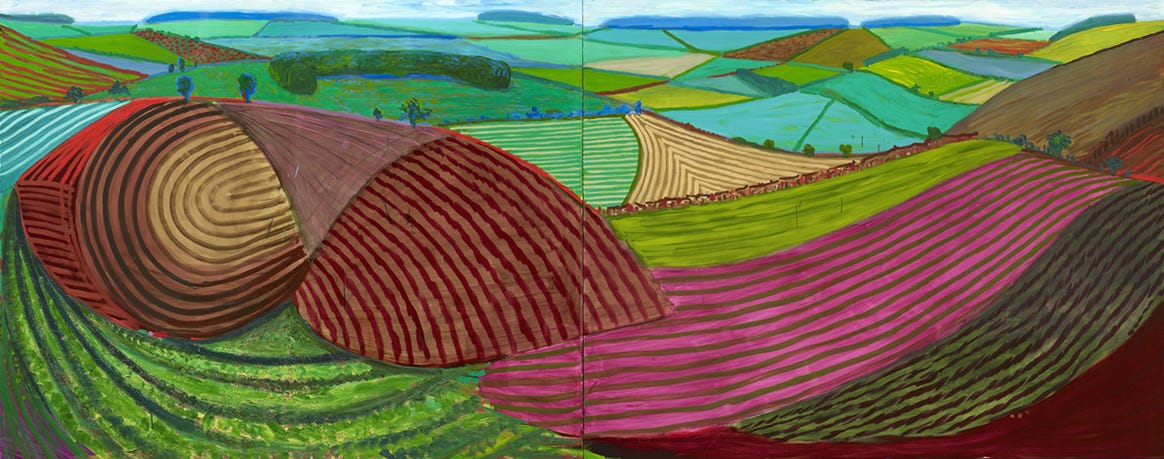
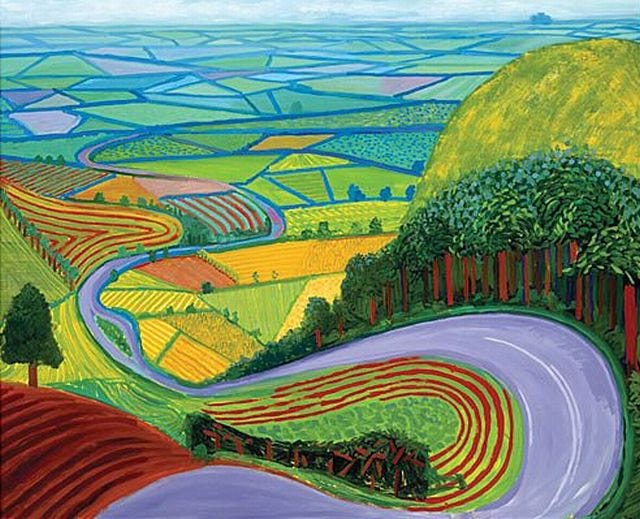
After his friend died, Hockney returned to Los Angeles, where he has lived permanently since 1978, holed up in his studio in the Hollywood Hills, and turned out, from memory, two more breathtaking Yorkshire landscapes: “Double East Yorkshire,” a voluptuous panoramic view of the puzzle-like farmland in scarlet, fuchsia and turquoise, and “Garrowby Hill,” an aerial shot of a violet country road weaving down to the lush green valley. Both are on view at the Pompidou.
Though “Espace/Paysage” contains some early masterpieces, including Hockney’s most famous pool painting, “A Bigger Splash,” and traces his progression from a realist portrait painter through his 1980s obsession with Cubist-inspired photocollage, it is the new landscapes that make the greatest impression on viewers. In fact, Hockney says that the Grand Canyon work has “revived him.” In more ways than one.
You can browse The Style Files’ curated shop for beauty, books, decor, film, sustainable fashion, and more here.
To keep up with my work:
Follow me on Instagram
Buy my books:
Listen to my award-winning podcast, The Green Dream, on Apple, Spotify, or wherever you get your podcasts.
The Style Files may earn a small commission if you shop via affiliate links in this newsletter.