
Le Grand Comeback
Parisians had all but declared the 200-year-old restaurant Le Grand Véfour dead. Its stylish revival proves that if you rebuild it, the fashion set will come.
By Dana Thomas for Air Mail
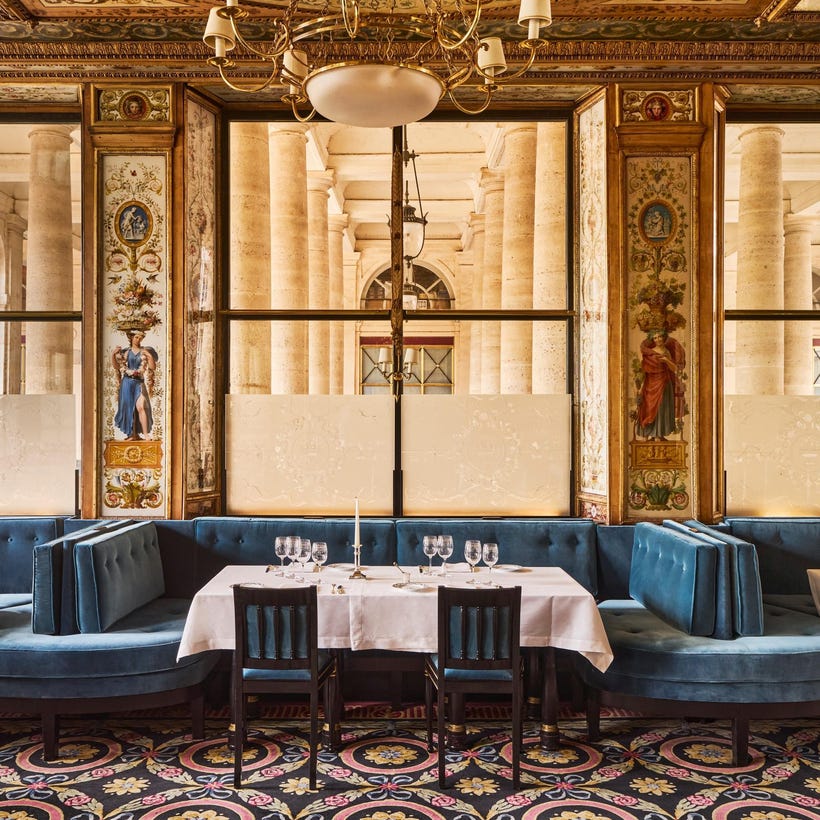
Walk into Le Grand Véfour, one of Paris’s oldest restaurants—and for much of its history, one of its haughtiest—and you’ll immediately notice something is different. The once stodgy crimson banquettes are now a cheerful royal blue. The plates are more industrial, less faux Versailles. The waitstaff is very young, and very fashionable—as opposed to old-school and serious. The diners are discreet, and Parisian, instead of the loud tourists who, in recent years, had commandeered the place. And there’s music, or rather contemporary “Muzak.” On a summer afternoon, it was Simply Red’s “Holding Back the Years” wafting through the elegant Directoire dining room where Napoleon romanced Joséphine, Victor Hugo held court, and Colette lingered over meals.
“Le Grand Véfour is a jewel, one of the best-known restaurants in the world, ” says Alexandra de La Brosse, chief marketing officer of Paris Society, the fast-growing hospitality group that recently took over management of the restaurant. “We wanted to bring Parisians back.”
Change is Paris Society’s specialty. Founded 15 years ago by Laurent de Gourcuff, the company got its start by creating some of the biggest see-and-be-seen restaurants that now define the city. (Think Monsieur Bleu at the Palais de Tokyo; Gigi in the glass-fronted room above the Théâtre des Champs-Élysées; Bonnie atop the SO/ Paris hotel.) It’s all extraordinary views. Chic clientele. Trendy food—burrata and truffles, anyone? And D.J.’s spinning club hits into the wee hours.
With only so many scenic spaces available, Paris Society soon shifted its focus to the city’s grand old institutions. In the last few years it has opened the wildly exuberant CoCo in the 19th-century Palais Garnier opera house; revamped Laurent, the elegant Belle Époque pavilion on the Champs-Élysées, and turned the Art Nouveau gem Maxim’s back into one of the buzziest places in Paris.
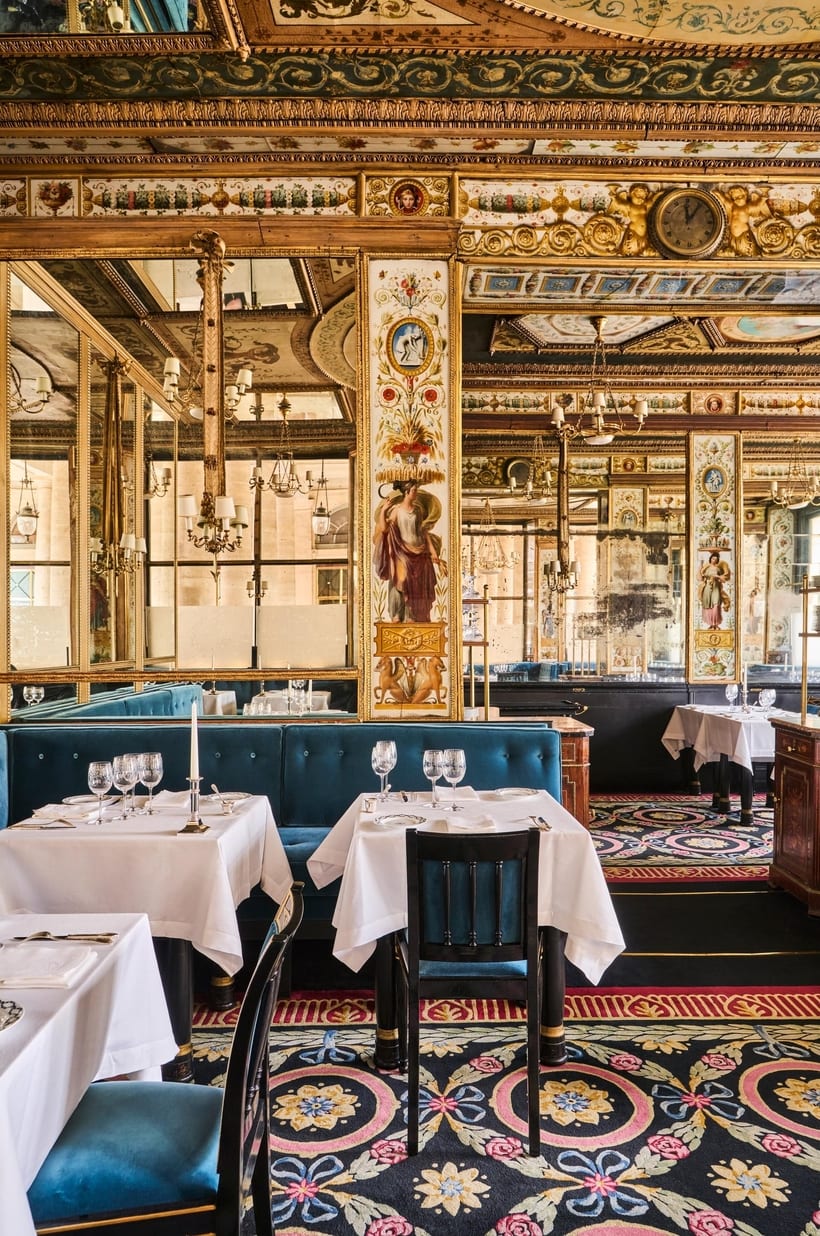
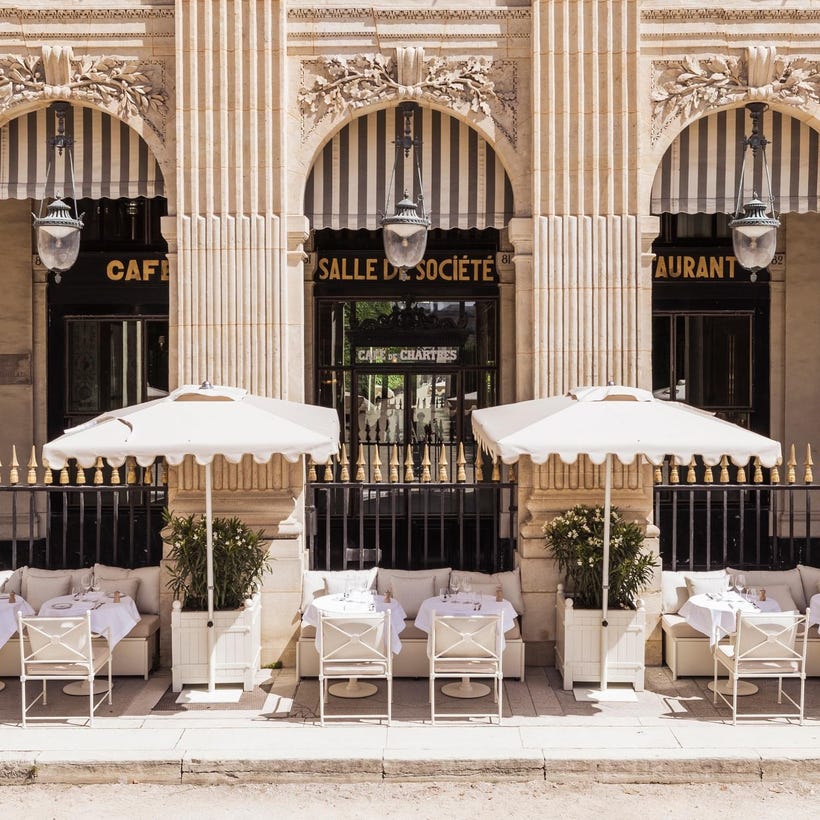
It was only a matter of time before Paris Society added Le Grand Véfour, which, for more than 200 years, has been, as Adam Gopnik noted in The New Yorker in 1997, “the most beautiful restaurant in the world and a cathedral of the cosmopolitan tradition.” Founded in 1784 as the Café de Chartres, it quickly became the political and social heart of the Palais-Royal. In 1820, Jean Véfour acquired the restaurant, lavishly redecorated it with its now-signature mirrors, painted panels, and gilding, and gave it the name it still bears.
In the postwar years, Raymond Oliver, a chef from Bordeaux and a Resistance hero, restored Le Grand Véfour’s culinary reputation, earning three Michelin stars in five years. He maintained them for three decades—until December 23, 1983, when a bomb exploded in the restaurant, injuring 12 diners and badly damaging the gilded rooms; French police never solved the case. In the aftermath, Oliver declared himself “ruined” and sold Le Grand Véfour to the Société du Louvre, a hospitality group owned by the Taittinger-champagne family. They restored the historic interiors, and, in 1991, hired Guy Martin. By 2000 he too had three Michelin stars.
Throughout the 1990s and early 2000s, Le Grand Véfour was the sort of place where men dressed in jackets and ties, women wore diamonds, and haute gastronomie dishes, such as paper-thin potatoes veiled with shaved black truffles and Le Pigeon Prince Rainier III, a deboned squab stuffed with foie gras, black truffles, and veal, arrived under a silver cloche lifted by a white-gloved hand. Members of the neighboring Conseil d’État (Council of State), Conseil Constitutionnel (Constitutional Council), and the Ministry of Culture lunched there; couturiers Yves Saint Laurent and Hubert de Givenchy dined there, as did interior designer Jacques Grange, a regular who has lived in Colette’s former apartment next door for decades. It was like a wildly expensive, terribly exclusive, utterly delicious club for foodies and snobs. In short: it was perfection.
Until it wasn’t. In 2008, Martin lost one of his Michelin stars—and, many food critics believed, rightly so. In 2018, Martin—who had owned Le Grand Véfour since 2011—sold a majority stake to Bangkok-based Mudman Public Company, franchisee for Au Bon Pain, Baskin-Robbins, and Dunkin’ Donuts in Thailand, as well as owner of shopping-mall cafés in Southeast Asia. Martin remained Le Grand Véfour’s head chef and managing director.
Then, in 2020, Martin was accused of sexual assault. Florence Châtelet Sanchez, a gourmet-food supplier, alleged that Martin attempted to rape her during a business meeting at the restaurant in 2015. Prosecutors opened a preliminary investigation, and Martin vigorously denied the accusations. No charges have ever been announced.
A year later, Martin “gave back” his two remaining Michelin stars, claiming he’d rather cook for ordinary diners than guidebook inspectors, and remade Le Grand Véfour as a middle-market brasserie, with bistro fare, low prices, and café tables under the arcades. The place was flooded with T-shirt-clad tourists and unruly children, who rolled around on the crimson banquettes. The salad was sandy. The feuilletée was soggy. Le Grand Véfour was no longer grand. The foodies and snobs fled.
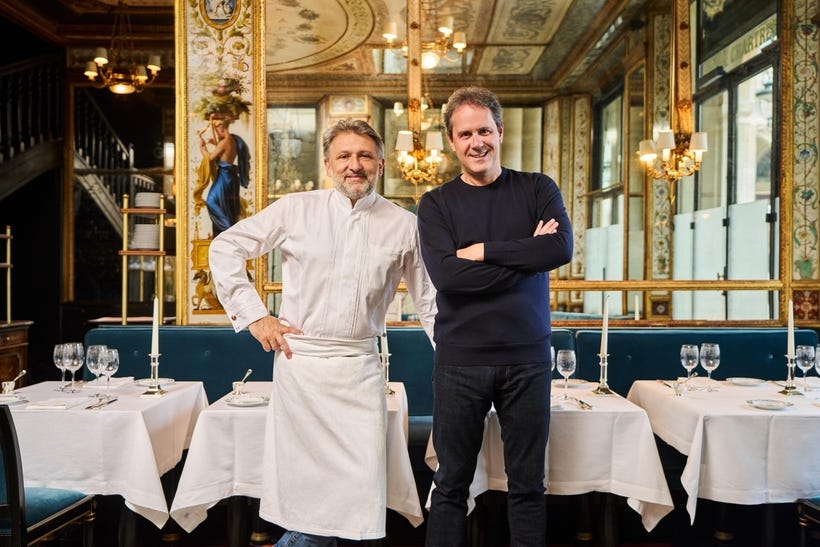
Last December, Martin announced that New Year’s Eve would be his final night at Le Grand Véfour—he said he planned to focus on his new luxury hotel in Puglia—and Paris Society took over. Unlike most of their properties, where the kitchens are staffed by anonymous cooks, Gourcuff decided he needed a star at Le Grand Véfour. Enter chef Bruno Doucet, the much-admired owner of La Régalade and Le Comptoir du Relais.
“They thought I would say yes immediately, because it was Le Grand Véfour,” Doucet tells me. “But I said, ‘I need to think about it.’ What mattered to me was whether it was professionally interesting—what kind of challenge it represented.” A month later, he accepted their offer.
Doucet devised a new menu, drawing on favorites from Le Comptoir du Relais and La Régalade, like his version of deboned squab stuffed with foie gras, served family style in a silver dish, with sautéed peas and baby carrots. It’s less precious and fancy than Oliver and Martin’s Pigeon Prince Rainier III, but at an eye-watering €92 it’s nearly as expensive. “High prices allow you to filter a certain clientele,” Doucet says.
Judging by the room, that strategy is working. Reopened in May with the tasteful modern touch of French interior designer Cordelia de Castellane, Le Grand Véfour once again feels like an exclusive club, but with members who care more about the scene than the gastronomy. To wit: Tom Ford creative director Haider Ackermann held his fashion-show after-party there this past March, with Lee Pace, Kate Moss, and Daphne Guinness—the British socialite who famously said, “I’ll eat when I’m dead”—in attendance.
“We aren’t looking for Michelin stars,” Doucet tells me. “The objective is to bring life back to a place that had become a little sad.”
Sign up for Dress Code, Air Mail’s weekly newsletter, here.
To keep up with my work:
Follow me on Instagram
Buy my books:
Listen to my award-winning podcast, The Green Dream, on Apple, Spotify, or wherever you get your podcasts.
The Style Files may earn a small commission if you shop via affiliate links in this newsletter.