
Please Join Us at Home
Elevated entertaining has come back into fashion. A look at how to host in a chic, modern way.
By Dana Thomas for Palmer.
Twentieth-century American heiress Marjorie Merriweather Post liked to receive at home—at Hillwood, her Georgian house set on 25 acres overlooking Washington D.C.’s Rock Creek Park; Camp Topridge, a rustic, 68-building compound in the Adirondacks; and Mar-a-Lago, her Palm Beach winter retreat, which she built in the 1920s. Her guest lists were a veritable who’s who of the era: captains of industry, politicians, diplomats, intellectuals, royalty. Dinners were as formal and elegant as those at Buckingham Palace or the White House, and followed similar protocol. “After all, I’m old-fashioned,” she told Life magazine in 1965.
When laying the table, her staff used yardsticks to measure the placement of every item. Each plate would sit exactly 16 inches apart. The porcelain was often by royal purveyors, such as the Manufacture de Sèvres in France or the Imperial Porcelain Factory in St. Petersburg, Russia, as was the flatware, like the vermeil originally made for Emperor Franz Josef of Austria. It would take the personnel all day to get the table just right. In the butler’s pantry, there were long, narrow drawers like those of a library card catalog. Each card noted the name of a guest, and the porcelain, silver, tableware, linens, menu, and fellow invitees, so that—at least in theory—nothing should be duplicated during the next visit.
“Entertaining like Marjorie Merriweather Post? I can’t duplicate that,” admits Palm Beach hostess Annette Tapert, co-author of The Power of Style: The Women Who Defined the Art of Living Well. No indeed—after all, Post had a staff of up to 300 at her three houses to help execute her events.
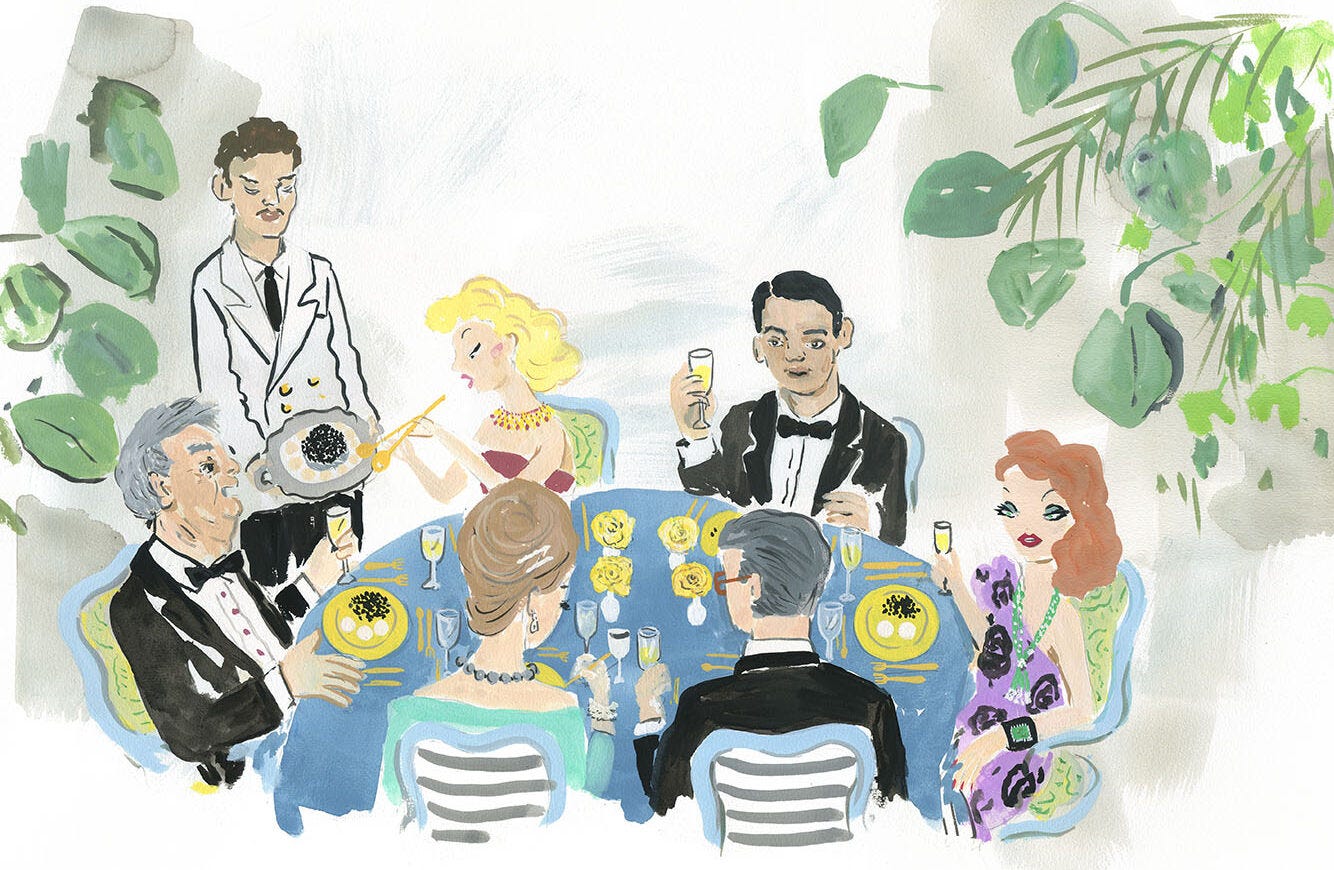
But after a long period of social casualness and monotonous restaurant dining—bye-bye luxury sneakers, platters of sliders, and party selfies!—elevated entertaining at home has come back into fashion. From Silicon Valley to Saint-Tropez, Beverly Hills to Palm Beach, young and old alike are gathering around beautiful tables for beautiful meals and beautiful conversation in beautiful homes.
Why the shift? With the world becoming more global and digitally connected, human interaction has lessened. The World Health Organization now reports that social isolation is widespread, with approximately 16 percent of people world- wide—one in six—experiencing loneliness. As anyone who’s ever been a wallflower can attest, one can feel profoundly lonesome in the midst of a big bash. Entertaining at home creates a more welcoming, communicative environment.
There’s the wealth gap: The National Institutes of Health reports that individuals in societies with greater income inequalities are more fearful of crime. “No one is going to wear nice jewelry at restaurants,” notes renowned Palm Beach hostess Carol Mack.
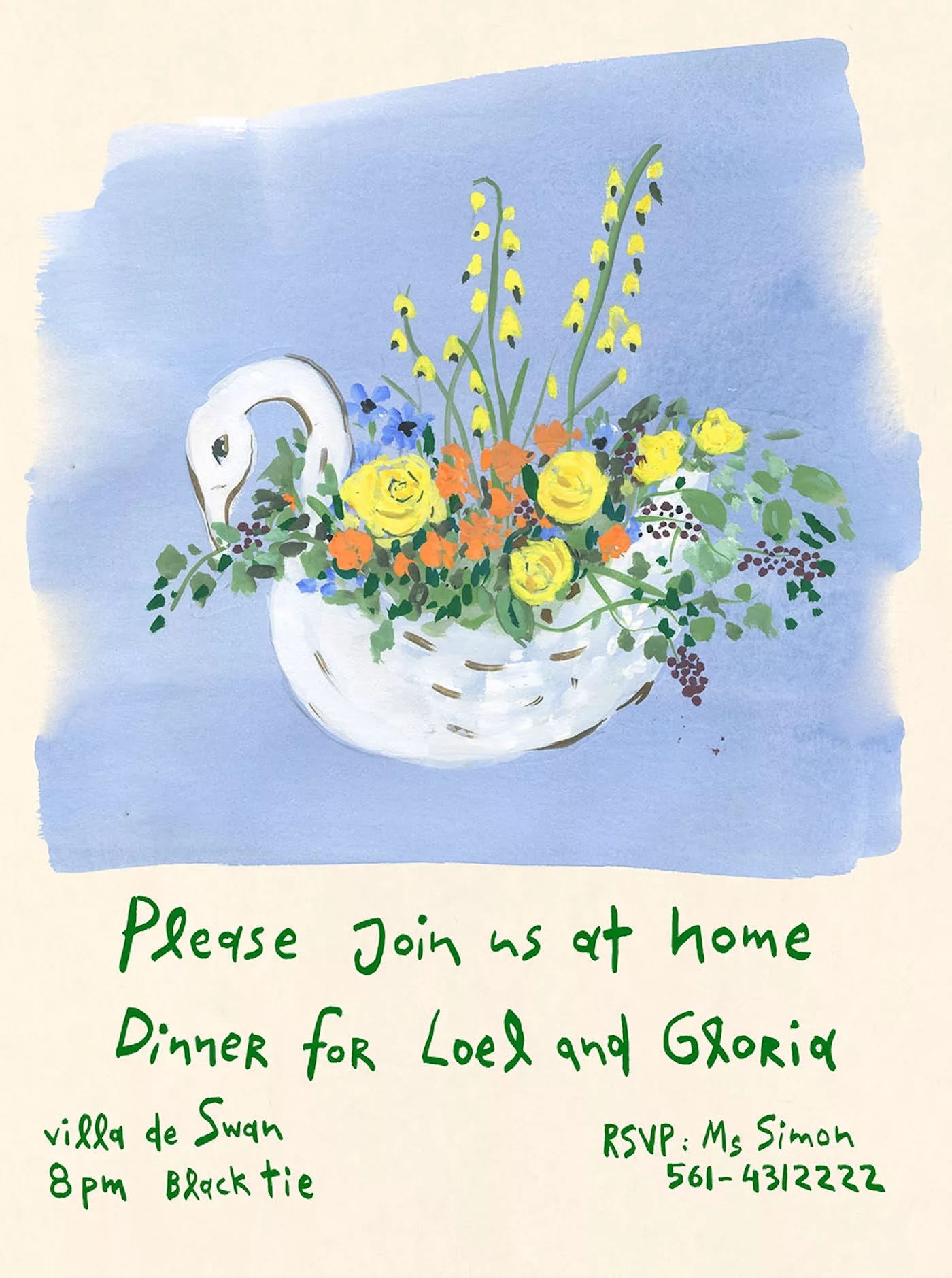
And in our age of ultra-exclusivity, there is nothing more personal and posh than receiving an invitation to dine at someone’s residence. “There is a very special authenticity to a seated dinner and cocktail buffet at home, with conversations to the right and left, candlelight, and delicious food,” says Rebecca Gardner, founder of the top events firm Houses & Parties, and author of A Screaming Blast: Exceptional Entertaining, recently published by Rizzoli. “It is the ultimate luxury to welcome your friends that way.” Palm Beach–based florist Lewis Miller puts it more succinctly: “A dinner at home is the new private club.”
The turning point seems to have come during the COVID pandemic, and not simply because of sheltering in place—though that has played a significant role. “People started using the dining room every night for dinner, and they thought, Why not use this room every day, instead of for special occasions?” explains interior designer Timothy Corrigan. At the same time, closet clean-outs brought forth long-packed-away porcelain, crystal, silver, and linens, and that all made its way to the table, too. “Everyone should be using their good stuff every day,” he says. “That’s why we have it. COVID fundamentally changed our relationships with our homes.”
Since then, Corrigan has received a steady stream of design requests for separate dining rooms, closed-in kitchens, butler’s pantries, wine rooms, and china closets. And it is a trend across the design business. “There is a huge return to the dining room,” he confirms.
Post-pandemic has also brought an enormous influx of new residents to the Palm Beach area. With that has come an array of diverse social mores. “There has been a surge of terrific people—younger, friskier, people who are actively working, rather than retired, as well as companies, art galleries, and restaurants,” says Hilary Geary Ross, wife of former Secretary of Commerce Wilbur Ross, and author of Palm Beach People. “I have been in and out of Palm Beach my whole life, so I have seen it evolve. Palm Beach has become more cosmopolitan. It’s the most fabulous, sophisticated small town in the world. And because you have people from all over the place, you have a wider range of styles of entertaining. It’s really like a mini New York now.”
Tables and buffets are set with bespoke porcelain and custom cutlery—Statement Tableware, it’s called, and it now accounts for 18 percent of the luxury tableware market—rather than with the 18th-century royal porcelain and vermeil of Post’s day. Platters are laden with a high-low mix of luxury delicacies, like caviar and truffles, and comfort food, such as mashed potatoes and biscuits. Ross likes to serve ever-so-tricky chocolate soufflés for dessert, then passes around Häagen-Dazs mini ice cream bars. “They are only 170 calories apiece,” she notes.
Fashion is following suit. At today’s intimate affairs, guests are more likely to dress luxuriously, but understated. “Men wear jackets, not necessarily ties, but collared shirts,” says Gayfryd Steinberg, a hostess and socialite known for her support of the literary arts. “Women are dressed in pretty things. They go to the hairdresser. There is an effort.” Ross concurs: “Here, people really dress up—more than in Southampton.” Luxury brands such as Brunello Cucinelli, Loro Piana, and Chanel have responded by offering evening looks beyond over-the-top red carpet dressing: The runways are now awash with cashmere sports coats, waist-forgiving maxi dresses, and ball skirts paired with boxy men’s shirts. These are luxury clothes meant to be worn lounging in a club chair after a meal, not swanning along a step-and-repeat. Of course, in Palm Beach, in particular, any look worth dessert is topped off with fine jewelry. “Good pieces,” says Mack. Ross laughs: “Look at all the jewelry stores on Worth Avenue. The brands know where the jewelry customers are.”
As Post proved, Palm Beach society has always been partial to at-home entertaining. “People have nice houses, so why not?” says Mack. And while Post liked to adhere to diplomatic etiquette when hosting—she was, after all, an ambassador’s wife for several years—she was also known, at least at Mar-a-Lago, to have a bit of fun, too. The 126-room Spanish-style mansion had a cinema for movie nights and a square-dancing room, with Post in a full-crinoline circle skirt and Mary Janes doing her do-si-dos. She once brought in Ringling Bros. and Barnum & Bailey Circus to perform on the estate’s 20-acre grounds—for her guests one day, and for a charity the next.
Post’s neighbors could be less imaginative. “Everyone had Neal Smith and his orchestra, and finger bowls on the table, and the same chef in the kitchen, and the same waiters serving,” Mack remembers. She and her husband, the real estate developer Earle I. Mack, have had their home in the South End since 1990, and her husband’s parents wintered in Palm Beach for years before then. “I remember a European woman said, ‘It’s like musical chairs. You go from one house to the next.’ It was a formula. But that generation has died off. Now everyone has their way of doing things.”
Aerin Lauder, heir to the cosmetics fortune and businesswoman, who says she entertains at least once a week, sets her tables with a mix of vintage finds and pieces from her own home line. Ross always has seated dinners, because, she says, “I don’t like wandering around looking for a place to sit.” She posts a seating chart in the entrance hall of their 1939 Georgian Revival home, so when guests arrive, they can see where they are placed and make initial contact with their dining partner during cocktails.
Steinberg keeps things simple: For a recent Saturday dinner for eight, the menu was caesar salad with her homemade dressing, followed by New York strip steak and roasted baby broccoli, and a Normandy apple cake she baked herself. “No foam. No tweezers. None of that stuff,” she says. Steinberg has help, of course—in the kitchen, and for serving, hired for the occasion. But since she and her husband, the writer Michael Shnayerson, love to cook, both don aprons, too. “Guests respond to such personalization and familiarity,” she says.
Tapert goes far more elaborate: For a book party for celebrity chef Alex Hitz, who hails from Atlanta, she created a southern estate in the garden, and for a recent luncheon for the National Council on White House History, she replicated the White House Red Room, with a table for 20 done in red, white and coral, and a movie screen backdrop projecting the 19th-century salon’s regal American Empire decor.
When it comes to planning the menu, right now, there is truly only one constant: “Caviar,” Mack says. “There is caviar on every plate everywhere you go.” Indeed, caviar sales are expected to rise by almost 8 percent annually until 2033, and the luxury online retailer Moda Operandi reports that one of its best-selling homeware items is a ceramic potato meant to be filled with mashed potatoes, topped with sturgeon roe. Not that you really need the dish: One Palm Beach hostess famously begins her dinners by serving baked potatoes in their natural, craggy jackets, then passes around a bucket of caviar with an enormous spoon—like the size you use for Thanksgiving stuffing. “After that,” Mack says, “nobody cares what else you serve.”
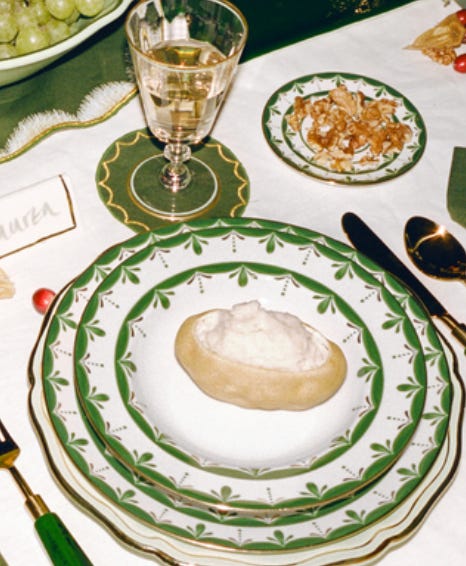
Naturally, all of this posh home entertaining has sparked a boom in the luxury tableware business: global sales are projected to reach nearly $40 billion a year by 2033. Brands that have dabbled in homeware for years, like Hermès and Dior, have expanded their product range exponentially. Others that had never bothered with les arts de la table are suddenly hawking top-drawer plates, forks, and knives, much of it available at Mary Mahoney on Worth Avenue. “That’s the mothership,” Mack says. “She has plates from every manufacturer, and if you want it, she orders it.”
Louis Vuitton introduced its first permanent high-end tableware in late 2023; the line includes Constellation and Splendor, both with patterns that play with the house’s iconic floral monogram print, on sale at its new boutique on Worth Avenue. Prada moved into fine tableware in 2021, and three years later introduced an exceptionally beautiful collection of snow-white Japanese porcelain enrobed with 24-carat gold. The pieces are handcrafted in Kanazawa, a city on the Sea of Japan renowned for its expertise in gilding.
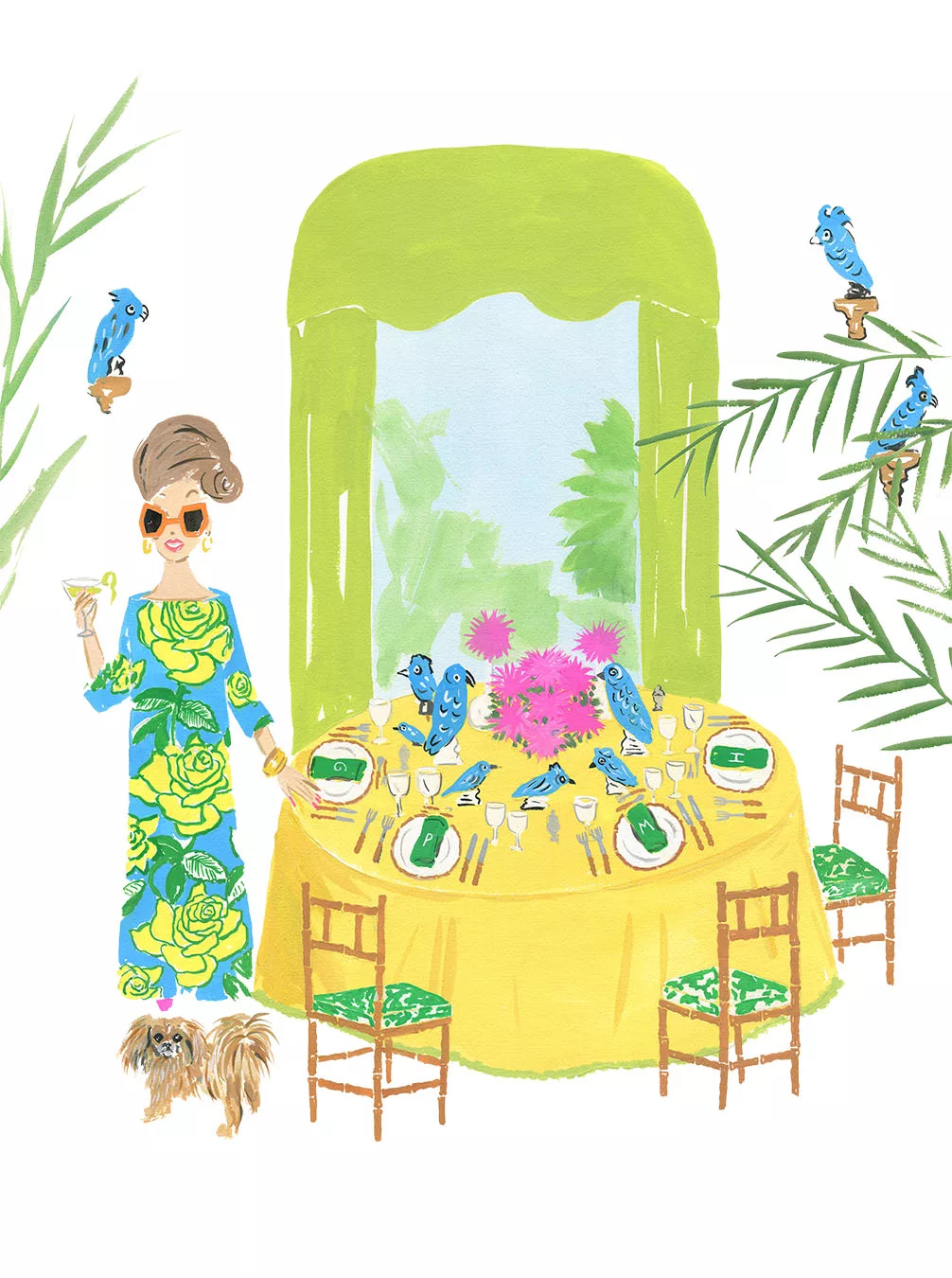
Hermès has been selling signature tabletop items since the mid-1980s—early editions featured pink peonies and cheerful toucans—and since appointing Benoît-Pierre Emery as the division’s creative director in 2013, it has brought forth a new porcelain collection almost annually. The latest one, Natures Marines, with oceanic flora and fauna by British illustrator Katie Scott, arrives in Hermès stores, including its outpost at Royal Poinciana Plaza, in March.
Ginori 1735, now owned by the luxury group Kering, has a plethora of new patterns, including Diva, a reinterpretation of the brand’s iconic Colonna line, originally designed by the Italian sculptor Giovanni Gariboldi in the 1950s, and Il Viaggio di Nettuno, or Neptune’s Voyage, which features jaunty drawings by British artist Luke Edward Hall of Greek and Roman busts and sea creatures, like octopi.
Dior has offered a small selection of decor and homeware by others in its Paris boutique for decades. When the brand’s flagship was redesigned by star architect Peter Marino in 1997, the homeware department got its own jewel box–like room in the center of the store. To oversee it, Dior hired longtime couture client Doris Brynner, the former wife of actor Yul Brynner and woman of exquisite taste. (In the early 1960s, Brynner spent a week in Palm Beach with her friend Gloria Guinness, a trip that included a visit with Mrs. Post, natch.) For 20 years, Brynner curated and commissioned the most divine selection of tabletop pieces, like hand-painted floral glass dinnerware by aristocrat artist Joy de Rohan Chabot, hand-woven raffia breadbaskets, Murano handblown glass vases, and crystal glassware engraved with forest scenes.
In 2017, Dior replaced Brynner with French socialite and tastemaker Cordelia de Castellane as artistic director of Maison. Two years later, Dior Maison had its own street-facing boutique next door. The following year, the flagship was shuttered for another massive overhaul by Marino. When it reopened, the Dior Maison jewel box was still in the center of the store, but now it was next to a restaurant called Monsieur Dior. Each table is set with the brand’s colorful porcelain, glassware, flatware, and linens. The cuisine, by Michelin-starred chef Yannick Alléno, is gorgeous and delicious. But really, all you think about during the entire meal is how you want everything it is served on, so you can use it for your own beautiful dinners in your own beautiful home.
Ed note: I serve as the European Editor for Palmer, the Palm Beach luxury magazine, which is published four times during “the season.” This piece appeared in Volume 10, out this month. If you’d like to read the complete issue, you can order a copy of the hardbound magazine here.
You can browse The Style Files’ curated shop for beauty, books, decor, film, sustainable fashion, and more here.
To keep up with my work:
Follow me on Instagram
Buy my books:
Listen to my award-winning podcast, The Green Dream, on Apple, Spotify, or wherever you get your podcasts.
The Style Files may earn a small commission if you shop via affiliate links in this newsletter.
Thank you for sharing this, Dana! I’m a fan of your writing!